Southside LIFE Drawing

Southside LIFE2

Alison Johnston


Whether you’re doodle daft or a working artist, life drawing classes can provide an outlet.

Life drawing’s prehistoric roots can be traced in caves around the world. However, as the practice evolved throughout the centuries, it became an art school staple. This trend was largely set by the Carracci family, in the 1580s, as they led the Accademia degli Incamminati in Bologna (Italy). This art school had its pupils first copy human form engravings; then plaster casts, before finally letting them draw a live model.

This strict approach has mellowed through the years and life drawing has returned to the masses. It is now estimated (by the Register of Artists’ Models) there are over 2000 life drawing employers in the UK; with many classes in residential venues. One such class is Glasgow Southside LIFE drawing.

LIFE drawing tutor, Alison Johnston said: “I started Southside LIFE Drawing two years ago after the class I had attended stopped. All the drawing classes I enquired about were in the city centre, and as a single mum I couldn’t find the time to travel to and fro. I therefore decided to start up my own class this side of the river.”

Johnston, a GSA graduate and qualified teacher, has since been running classes fortnightly on Tuesdays (7 to 9pm) in Argosy Bar function suite.

The suite is set with background music, tables, and chairs.

Johnston said: “It’s a very relaxed class. I play chilled out music and there’s a little break half way through when people chat and nosey at one another’s work.  There’s also the opportunity to bring a wee drink up from the bar downstairs.

“The suite has plenty of tables, but students can bring an easel if they prefer. There is lots of room and, unlike other classes, you don’t have to fight to get a good view of the model.”

The open atmosphere is furthered by LIFE drawing’s diverse mix of students.

Johnston explained: “The class is very mixed in gender, age and ability. I have people who haven’t drawn since school, mixing with secondary school students, and very competent and working artists. The class is open to everyone.”

Classes are £10  and £7 for students (in education). Beginners can join with just a sketchbook and drawing implement. Usually extra paper and materials are also on hand, for those who fancy variety.

Johnston said: “Beginners need not worry as I’m there to give advice and help out where I can.”

“Life drawing is a fantastic way to relax! I find time disappears really fast when drawing.

“The common misconception is its sleazy; it’s nothing like that at all. I have a fantastic group of very professional life models who are posed in various positions – either standing, seated or reclining.”

Sessions usually start with several brief sketches, before going on to more in depth poses, and usually concluding in two half hour poses.

Students can build upon their skills by attending multiple classes, but Johnston explained, block bookings are not mandatory.

She said: “I’m aware sometimes students can’t attend every week due to other commitments, but they can keep abreast of all the latest session dates through the group’s Facebook page.”

The Southside LIFE drawing Facebook page also offers pictures of the student’s sketches and answers to their queries.

Johnston concluded: “Lots of people say life drawing is something they have thought about trying; so why not come along and try it for yourself? It is open to all and can be a great new skill.”
 

Travelogue

Travelouge 3

If you enjoy Nordic fiction, then why not explore the landscape through visual art? This voyage can be taken in Glasgow’s Briggait (studio) through Clive A Brandon’s Travelogue exhibition (running April 27 to June 5).

Travelogue showcases Brandon’s work from residencies in Norway, Scotland, Sweden and Iceland.

He explained: “I had visited Scandinavia several times before Travelogue and had a yearning to explore these countries more deeply. I loved the atmosphere and wanted to experience what it was like to live and work there, even if only for short time.”

In April 2013 Brandon left for a 20 month journey through Northern Europe, completing residencies that examined natural and manufactured elements of remote places.

He said: “I wanted to see how my work, which had become very ‘urban’, would develop in natural landscapes.”

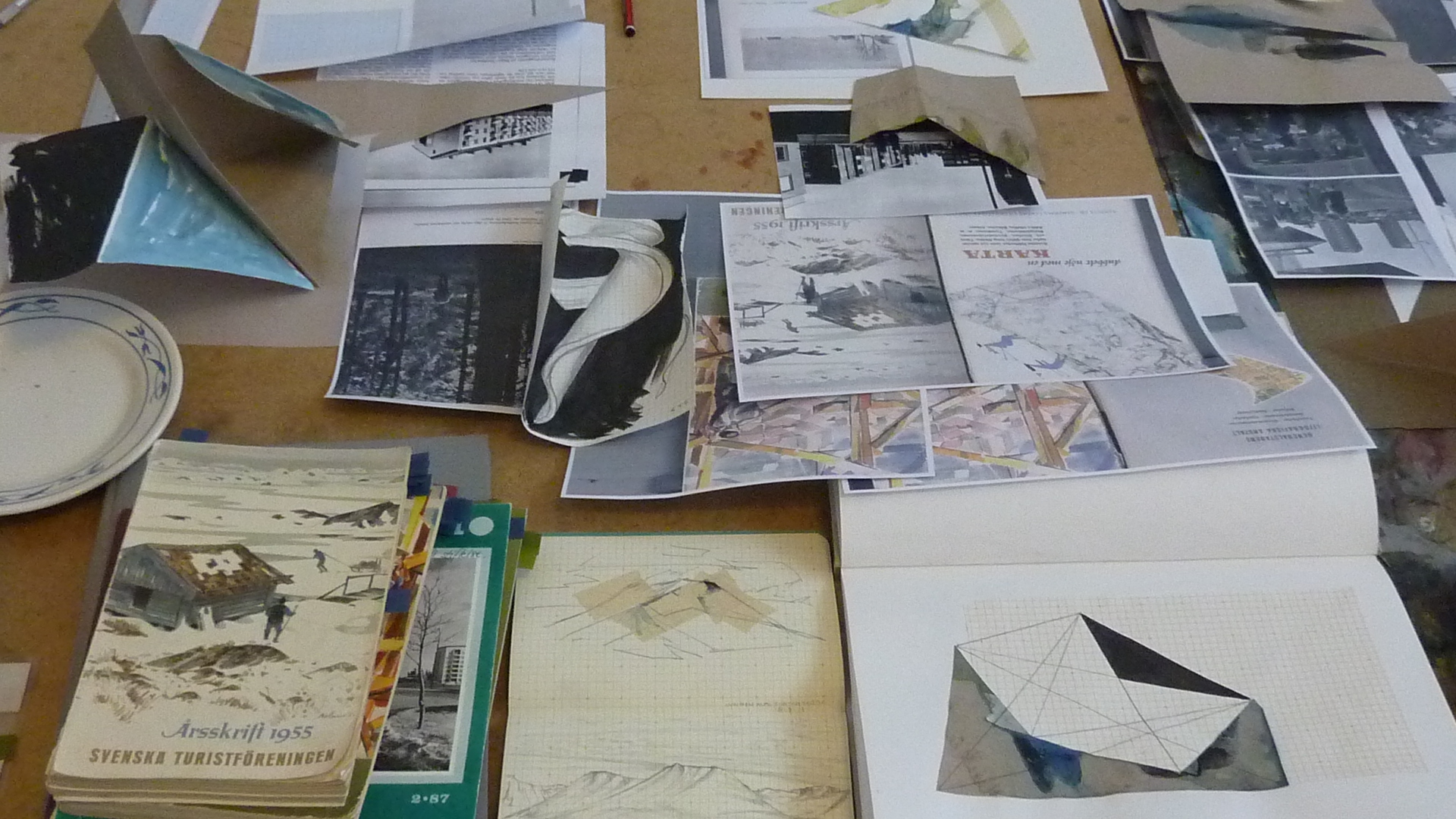
Brandon explored these landscapes through excursions; making photos, sketches and watercolours that he combined with recycled materials and local information. These became a bricolage of material.

Brandon recalled: “When travelling I couldn’t carry very much, so I worked out a basic art kit with a watercolour travel set, acrylic paint, brushes, canvas, watercolour pads, moleskin sketchbooks, scissors, pens/pencils and graph paper. I made a rule that this all had to fit into an A3 folder and pencil case.”

On arrival at each residency, Brandon scoured the area for base materials such as cardboard. This often involved rummaging through recycling bins or asking strangers for shoe boxes.

He said: “I did get some strange looks, but if anyone asked what I was doing I just told them I was an artist, which normally excuses all sorts of behaviour.”

At the end of each residency Brandon would package most of his work and post it back home.

He added: “I left different things at each place; sometimes pieces just wouldn’t fit in postage, other times I donated paintings or sketches to my hosts.”

Meeting interesting people was – Brandon said – one of the highlights of his trip. He listed other highlights as: challenging his work patterns, having to be resourceful, seeing amazing countries and living like a local.

However living like a local was not always easy.

Brandon explained: “Before Travelogue I had never done any residencies; so arriving in another country without familiar studios, friends or materials was hard.

“The first day of each residency was a bit strange; I would arrive to an empty room and wonder how I was going to make something from nothing.

“My first actions were normally to get some ideas up on the walls, rearrange the space and make it feel like mine.”

After setting up, Brandon absorbed his environments by collecting materials and making sketches, this – he said – helped him to relax and built towards his final projects.

He added: “I’m really happy with the body of work I produced, which is why I was keen to collectively show it when I returned.”

Before his travels Brandon lived and worked in England, having studied an MA at Wimbledon and BA at Leicester De Montfort.

Upon returning to the UK Brandon started touring his exhibition.

He said: “I found that travelling can be a brilliant experience that can change your work forever.

“To any artist considering working abroad I would say: plan ahead, set goals (but have an open mind and avoid being too prescribed) then get to know the local people and arts scenes.”

International residency opportunities can be found at Res artists’, Transartists’ and WASPS studios’ websites.

WASPS studios hold special resonance with Brandon, as they are hosting his Travelogue exhibition.

Brandon said: “This is my first Scottish show and first solo show in the UK, so it’s a very exciting time.

“I hope people will get a lot out of Travelogue; it is a large body of work that allows viewers to immerse themselves in the sense of place. It shows how palettes change with the seasons, and landscapes shift from rolling hills, to forests to volcanic areas.”

Travelogue dates and locations can be found on Brandon’s website.